


Experiencing the Taiwan Indigenous Village: A Journey with the Rukai Tribe-- By Melody Tan
- Melody Tan
- Sep 14, 2025
- 4 min read

Introduction
An indigenous group from Taiwan, the Rukai tribe is well-represented in Pingtung County, especially in Wutai Township's high-mountain region. Once devastated by the 2009 Typhoon Morakot, most residents were relocated, though a few, including the Sumuku Homestay operators, remain. A social class system governs Rukai society, which is renowned for its unique customs like slate construction and lily decorating. It also boasts a rich cultural legacy that includes festivals for millet harvesting and bead embroidery. Rukai settlements may be located in Wutai, Sandimen, Majia, and portions of Neipu townships in Pingtung. They have formed tribal assemblies to preserve their culture and support self-governance.

Arrival at the Village
When I first arrived in Pingtung County, the most southern part of Taiwan felt both familiar and new. The air was heavier with mountain mist, and the roads curved deeper into Rukai territory. The air carried a cool mist, that’s when I immediately knew that I was stepping into a place where the land itself holds memory. No, this was not a forced school project , nor a just a fleeting tourist stop — it was a personal journey to live, even shortly and briefly, alongside the Rukai people and to understand the rhythm of their traditions.
The moment I stepped foot into the heart of the Rukai Village,I was met with a moment I will never forget. Children peered out from behind their classrooms as their bell rang (it was not a standard bell, it was their traditional song), eyes wide with curiosity, and immediately waved directly at me, before breaking into song — a traditional melody played gently on a guitar by the locals at the village. They welcomed me not with words alone, but with music, their voices carrying across the village. I had never felt more welcome, and as they smiled, they greeted me with ‘Sabao,’ the traditional greeting of their tribe. Then, one by one, they carefully placed beautiful flower headbands on our heads, a gesture of warmth, respect, and welcomeness. In that instant, I felt the rhythm of the community, a heartbeat that was both ancient and alive, and I knew that this experience would be more than a visit, that it would be a full immersion into a living culture.
Educational Lectures
My immersion began at National Pingtung University, where I attended a lecture that framed the days ahead. The professor spoke of how natural disasters: landslides, typhoons, earthquakes had completely ruined the Rukai villages and disrupted the lives of these rukains. Yet through this devastation was a story of resilience and toughness of how communities responded with social practice projects, innovative rebuilding, and an unwavering commitment to protecting their culture.
As the day progressed, the lecture’s ideas came alive. Walking narrow paths with community guides, I saw how every corner carried their own history. The locations of houses that had been abandoned following natural disasters were reached by a different route. The environment felt like an open book, with each tree and rock feeling like a children’s picture book. I realized after listening to the stories that preservation was not a concept. It is where people gathered, worshiped, cooked, and thought.

Traditional Crafts
Another unforgettable moment was when I was invited to participate. In a small gathering space, I joined members of the Rukai in making traditional food. (Chicken and taro rice Zhong Zhi). The earthy scent of millet filled the room, and the sharp smell of the freshly cooked rice. My hands clumsily tried to mimic the practiced movements of the women around me, kneading, wrapping, and preparing ingredients that had continued for generations. As I tried to wrap my Zhong Zhi, I heard laughter when I stumbled, and saw patience in the eyes of those teaching me.
Later, I took part in craft activities, watching how natural materials were transformed with careful skill.
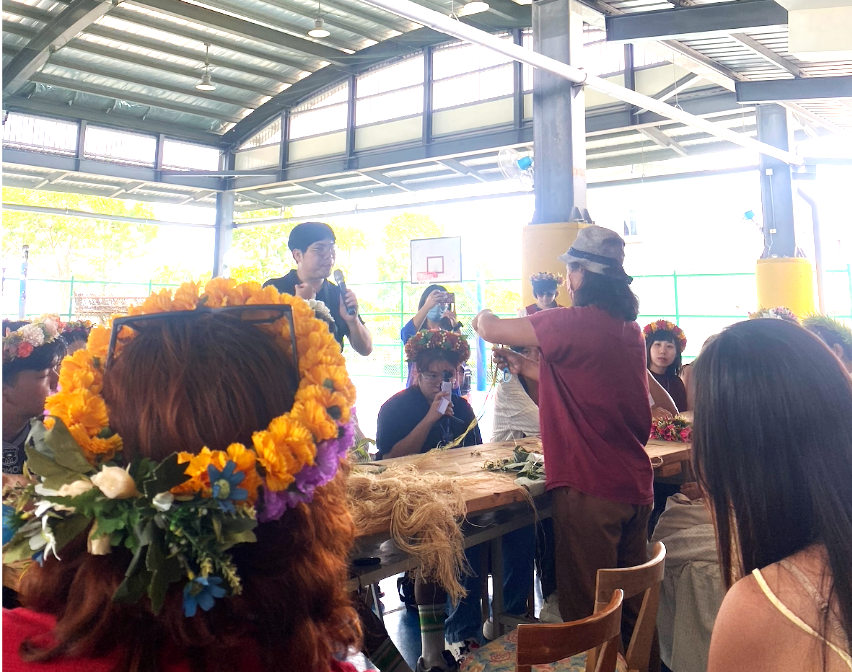
I attempted to wrap the green,yellow, and red strings (color of their flag) around some sort of bamboo. The weaving of patterns and the shaping of designs carried stories that words alone could not capture.
Reflection
As I left the village, the sounds of the children’s laughter and the smell of roasted taro rice with chicken lingered in my memory. In my hands, I carried more than just the tangible gifts they had shared with me—the handmade crafts I tried shaping alongside them, the sweet mochi filled with fresh fruit, the comforting rice tea poured with care. I carried with me more than notes and photos , I carried a lesson about resilience, community, and the power of living traditions. To live even briefly alongside the Rukai was to realize that culture is not just preserved in museums or textbooks, it is preserved in the daily practices, the shared meals, the stories told, and the songs sung beside a fire.


Comments